
Ufra Mir | Kashmir
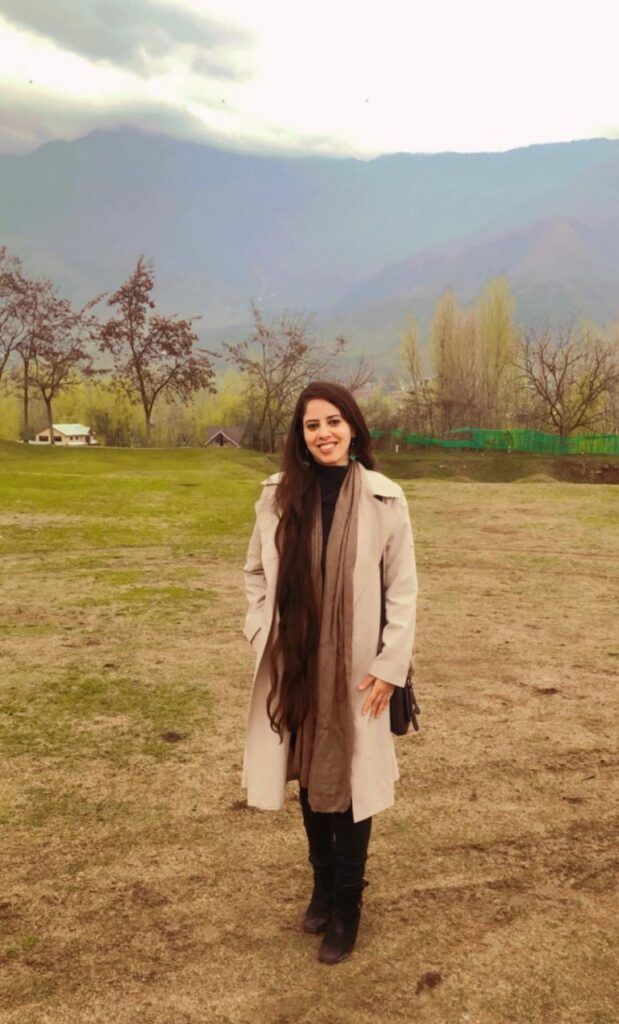
In Kashmir, where beautiful landscapes coexist with decades of conflict, Ufra Mir grew up with curfews, shutdowns, and daily violence as a part of ordinary life. From a very young age, she recognized that something in her reality was deeply wrong, a realization that would shape her lifelong commitment to helping people heal and find meaning amid ongoing conflict.
Ufra deepened her education in peace psychology throughout her time in high school and during her subsequent scholarships abroad, where she began exploring how holistic well-being connects to long-term peace. Returning home, she found that even the words ‘peace’ and ‘psychology’ were met with suspicion. In a society where trauma was widespread and mental-health services were scarce, she began with the basics: listening, acknowledging pain, and creating empathetic spaces for expression.
These early efforts evolved into a life dedicated to peace psychology, a practice aimed at understanding how people cope with conflicts and building the tools and support they need to hope and survive in complex, violence-affected environments. For Ufra, psychological well-being is not a reward that comes after peace; it is a foundation for achieving it. She cannot imagine sustainable peacebuilding efforts, without creating space for psychological wellbeing, emotions, trauma and fears. She explains, “It’s essential to build windows of calm and spaces for peace amidst the conflicts continuously rather than seeing peacebuilding as a futuristic activity, because I believe peace is a process, not a product.” (Click here to watch the TED Talk.)
Through the organization she founded, The International Center for Peace Psychology (ICPP), Ufra works on decolonial, community-centered and contextualized peace-psychology practice and on integrating mental-health and psychosocial-support principles within the larger context of conflicts in the peacebuilding space. The ICPP’s programs combine psychology, education, art, culture, and innovation to create supportive spaces for communities. Initiatives such as Baawunn help women (half-widows) whose husbands have disappeared in Kashmir by combining psychosocial support with community engagement, spiritual healing, and creative expression.
Another key initiative, Zuun-e-Daeb, which literally translates to a moon-gazing room (attic) in a traditional Kashmiri home, offers workshops in storytelling, art, and reflection. These spaces encourage participants to take charge of their own narratives and counter what Ufra calls “the enforced normal,” the numbing acceptance of daily violence. Across her experiential workshops, she emphasizes empathy, emotional literacy and wellbeing, and creative thinking, helping people see emotions as sources of strength rather than weakness, and acknowledging self-empathy as a path to understanding others within the larger cultural context of the ideas of self-care and nurture that are deeply intertwined with their connection to the community.
Beyond Kashmir, Ufra’s influence reaches internationally. She advises global organizations and forums on integrating mental-health and psychosocial support into peacebuilding through culturally sensitive and decolonized approaches. She has received recognition and awards from international-forums for her pioneering work in Kashmir and South Asia.
Despite these global roles, Ufra remains rooted in the realities of Kashmir. She emphasizes that peace must be understood on multiple levels – personal, interpersonal, communal, and political, and that while achieving political peace is a common aspiration, the well-being of people living in conflict zones cannot wait. As she puts it, “If one doesn’t even know or understand how to construct one’s own pieces of peace, what is there to construct tomorrow?” (Read more at Women’s Regional Network.)Through peace psychology, Ufra invites communities to begin that construction every day, reclaiming empathy, imagination, narratives, and dignity even when the world around them feels unpeaceful. Her work is a testament to the idea that peace is not simply the absence of violence, but an ongoing, transformative process that nurtures both individuals and communities.
For Ufra, her work is deeply spiritual, rooted in her faith, and therefore humbling. She takes inspiration from her community, culture, and local practices which keep her grounded despite all the chaos and challenges. She also spends her time doodling, painting, writing, cooking, star-gazing; all part of her constant struggle to create meaning and joy in an otherwise very broken world.
Tanenbaum awarded Ufra the 2025 Peacemaker in Action Award.