
An interview with Tanenbaum Peacemaker in Action, Ricardo Esquivia Ballestas
By Yazmin Muñiz, Peacebuilding Intern
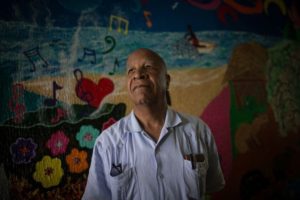
Tanenbaum Peacemaker in Action, Ricardo Esquivia Ballestas. | Ivan Valencia for The Washington Post
Pieces of the Colombian Peace Pie: Political Division, Justice, and Unifying Spirituality in Colombia’s Civil War History and Present
Yazmin is a Junior at Cornell University, majoring in English and government. She holds a deep intersectional interest in international politics, law, and conflict resolution. Yazmin interned with Tanenbaum as a Spring/Summer Intern for the Peacebuilding team.
As part of her final intern project, Yazmin interviewed Peacemaker in Action Ricardo Esquivias Ballestas in Spanish on Thursday, July 31st, 2025.
On June 7th, 2025, Colombian presidential candidate Miguel Uribe Turbay was shot at a political rally in the streets of Bogotá, Colombia. On October 28th, 2023, Luis Diaz, a star Colombian footballer for Liverpool, received news that his father was kidnapped by ELN (National Liberation Party). Although these incidents were two years apart, under different circumstances, both allude to larger issues facing Colombia since the mid-20th century: armed violence and polarization.
Colombia’s struggle with political violence, otherwise known as La Violencia, or The Violence, can be traced to a period of conflict in the 1940s. As the 1946 Colombian presidential election campaigns began, Liberal candidates Gabriel Turbay and Jorge Eliecer Gaitan faced a Conservative challenger, Mariano Ospina Perez. After nearly a decade and a half of sidelining by Colombian liberals since the 1930s, Perez was able to claim a victory for the Conservative Party in August of 1946 – a loss of political safety for Liberal Party leaders, including Gaitan.
On April 9th, 1948, the assassination of Gaitan, then leader of the left-wing Liberal Party, incited a series of overnight riots nicknamed the Bogotazo. After this infamous election cycle, the decades that followed would also be marked with increasing political violence.
In the 1950s and early 60s, the Colombian peso saw devaluation. Falling coffee prices, domestic unemployment, and flatlined import substitution led to a reliance on the United States through its Alliance for Progress program for Latin American economic development. However, such an overreliance was detrimental to the working class, people experiencing poverty, and those who did not benefit from the constant fluctuations of business and a lack of Colombian stewardship in development.
The 2025 assassination and 2023 kidnapping highlight the dark solution to disagreements at the social and political levels: violence.
The armed forces who kidnapped Diaz’s father, the ELN, formed because of Colombia’s decades-long political and economic dissent. Alongside the FARC (Colombian Revolutionary Armed Forces), students who witnessed Cuba’s socialist governance opted to create a Marxist-Leninist faction. Other similar groups like the M-19 would later appear and execute high-profile coups like the Palace of Justice siege of 1985, which killed several Supreme Court magistrates and resulted in more than 100 deaths. These armed groups often claimed to be the inheritors of Colombia’s struggle and believed violence was necessary to enact their goals.
The years that followed were plagued by kidnappings, extortion, and forced disappearances. From the 1980s onwards, hundreds of people were killed, at one point daily.
The 90s introduced the boom of international drug trade, organized crime cartels, and the most high-profile drug kingpin, Pablo Escobar. Later, guerrilla groups in the 2000s began using the suicide collar-bomb, whose first victim was Elvia Cortes, a dairy farmer from the Boyacá province. Concurrently, thousands of young, impoverished men disappeared after being offered jobs by the Colombian military. The extrajudicial killings were part of the Colombian military’s mass murder of civilians to meet guerrilla capture quotas (minimum number of arrests or ‘neutralization’ of armed group participants). Overbearing foreign and domestic pressure to end the civil war prompted these acts. Thus, from both the state and guerrilla sides, those at the bottom of the socioeconomic scale were the most affected. Poverty, rural residence, and youth became markers of inevitability – inevitability that you, as a Colombian, would be caught in the middle of armed conflict too.
This was the reality for the people of Montes de Maria. An isolated group of mountains, Montes de Maria sits in the coastal Caribbean region between Colombia’s Sucre and Bolivar departments.
Many residents, including Ricardo Esquivia Ballestas, Tanenbaum Peacemaker in Action, and founder of Sembrando Paz, reside in the rural valleys of the municipality.
As a long-time resident, Ricardo noted there have been over “120 massacres” in the region, causing mass displacement and heightened armed warfare. He and his family members cite that the conflict “affected them very much,” ultimately leaving them “displaced to Cartagena, then to Bogotá, then to the United States.” After a long journey, he eventually found himself back in Montes de Maria, where he dedicated his time and skills as a human rights lawyer and a long-time resident to foment peace through his organization Sembrando Paz.
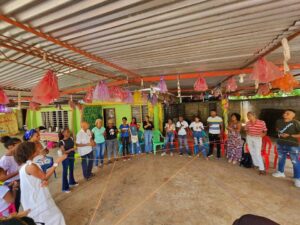
Promoting peace is no easy task, and Ricardo knows this. He often uses basic mediation and conflict transformation tactics like dialogue across conflict camps, spearheading an initiative called re-encuentro de igual en desencuentro (reunion of equals in disagreement). Originally pitched around 25 years ago with the inception of Sembrando Paz, dialogue continues to be a crucial way in which the hundreds of residents of Montes de Maria can gather, plan, and reflect on issues from armed conflict to the effects of drug smuggling passageways nearby.
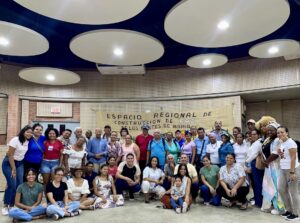
But, like many proponents of peace, Ricardo’s safety is always at risk. Ricardo recalled a time when “eight different armed groups were inciting conflict” in Montes de Maria, with some instances ending in multiple tragedies. He decided to build an integration center titled Espacio Regional de Construcción de Paz de Montes de María, or the Regional Space for the Construction of Peace of Montes de María. The center offered a pillar of support and encouraged groups of 50-80 community members to congregate “almost in a religious way.” Numerous support sessions, one-on-one talks, and dialogue exchanges are the bulk of the center’s mission and continue to be a powerful tool for those in the community who feel voiceless because of the civil war.
Though Ricardo’s work is rooted in dialogue, it extends into a larger set of ideals under what he calls the ‘humanitarian code.’ This code is grounded in his belief that “human rights are a code, a foundation that helps us understand each other and understand that justice is progress.” The code itself is composed of a variety of intersectional systems and ideas that are important in nations battling through civil war: justice and spirituality.
Ricardo describes justice as an intersection between state action, the law, and human rights, where one must understand the “role of the law” to reach peace successfully. The rules still apply, no matter who one is. Though he acknowledges that “nowadays there’s a mistaken idea that law is justice,” and it is an area where one should tread carefully. He describes law as a form of ‘political justice’ that is often flawed in civil war situations. He invoked the example of the 2016 peace treaty under Ex-Colombian President Juan Manuel Santos, where the treaty only mitigated the conflict between the Colombian Republic and the FARC. President Santos neglected to address the dozens of other active groups. In other words, only the government ended up acquiring peace, not the Colombian people.
Ricardo affirmed that “the law is merely a political agreement that pretends to get closer to justice” and is not the end-all be-all simply because of international recognition or a Nobel Peace Prize. There is still a lot of work left to do.
The second aspect of Ricardo’s humanitarian code is his belief in the unifying ability of spirituality. Despite his identity as a Mennonite Christian and his acknowledgement of Colombia as a Christian-majority country, he approaches the inclusion of faith at a much more fundamental level. He believes “there is not a singular God for everybody … the form in which we interpret him is entirely cultural.” Thus, as a leader in Montes de Maria, he has the unique mission of finding that connection to mediate with “something that permits us to amplify the vision just a bit beyond our particular culture.”
His vision aims to unite the many minority groups that are represented in Colombia, including Jewish, Muslim, Buddhist, and atheist Colombians.
Remarkably, his vision ties back to his pillar of justice. Ricardo’s vision of unity derives from the Bible, Qur’an, and other texts that hold their own “codes” representative of the people who reside in Colombia and Montes de Maria. He clarifies that in all religions, there is an overlap in that code, usually teachings that promote respect, tolerance, and open-mindedness to each other’s differences.
This blend of spirituality and justice conveys a vital message: “I can get closer to you, and you can get closer to me.”
Ricardo’s work has challenged the broad peace initiatives spearheaded by the Colombian government. Before the 2016 Peace Treaty was signed with the FARC, a plebiscite was distributed to gauge the people’s agreement with the conditions, and the people voted “no.” The treaty still passed. Even under harsh public scrutiny, there wasn’t enough motivation to develop and tackle such an intersectional issue. Yet, Ricardo’s work managed to do the very thing Colombia has failed to do to achieve unity.
Despite constant political persecution from local paramilitaries like the BACRIM (Los Urbanos), the prosecutor of the department of Bolivar, and accusations of FARC-EP involvement, Ricardo continues to host seminaries, encourage dialogue, and advocate for a better Colombia. Moreover, his resistance to political pressure and humanitarian achievements have been recognized not only by Tanenbaum, but also by Amnesty International, The Latin American Working Group, Pulitzer Center, and the Aurora Humanitarian Initiative, among others, all citing the importance of his work.
So, what does this mean for the future of political division and war in Colombia? In the world? It means negotiations do not have to be done without public approval, or in the heart of revolution in Havana, or through formalized government – it begins with one-on-one dialogue.
Ricardo urges us to think of mediation, resolution, and agreement “from a perspective of faith, but faith in hope, in human rights, and peace.” Then, just then, peace might be feasible.
Learn more about Ricardo and read his case study in Peacemakers in Action: Volume II: Profiles in Religious Peacebuilding.
If you or someone you know is interested in interning with Tanenbaum’s Peacebuilding program, please email [email protected].