
An interview with Tanenbaum Peacemaker in Action, Ricardo Esquivia Ballestas
By Audrey Maize, Peacebuilding Intern
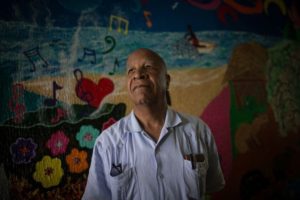
Tanenbaum Peacemaker in Action, Ricardo Esquivia Ballestas. | Ivan Valencia for The Washington Post
Peace is the Fruit of Justice
For over 40 years, the armed conflict in Colombia has taken various forms across the country’s diverse terrain. The valleys, riverbeds, forests, savannas, and steppes are all home to different populations; therefore, guerrilla conflict and the narcotrafficking crisis have needed different solutions.
2016 marked a historic peace agreement between the national government of Colombia and the Revolutionary Armed Forces of Colombia (FARC). Since then, the Colombian national government has implemented a variety of solutions with inconsistent efficacy, mainly in metropolitan areas like Medellín, Cali, and Bogotá.
Colombian national and Tanenbaum Peacemaker in Action Ricardo Esquivia Balletas finds himself fighting for one solution in Montes de María, a sector of rural northern Colombia which became the epicenter of the continued armed conflict. What makes Montes de María so uniquely susceptible is its proximity to both the Caribbean coast and the Rio Magdalena, creating a perfect route to smuggle illicit substances – drugs out, firearms in. Despite its small size, it’s a hotbed that armed groups like the Clan del Golfo are desperate to control.
Sembrandopaz, Ricardo’s organization, works in the wake of the conflict to address its lingering symptoms. The initiative seeks to build prosperous community networks, with the belief that fostering such a community could empower citizens in the face of violence and help them create solutions for their own people. The grassroots movement works among the unique conditions of Montes de María, filling a need caused by the Colombian state’s failure to act.
This rural community, like many others in the country, is affected by certain geographically unique needs. But more often than not, the state does not meet those needs. “When it doesn’t,” Ricardo says, “the armed groups are the ones that give response to those needs. And they start to impose themselves.” Members of these communities don’t prefer these armed groups to take control of the territory – sometimes it’s just the best option. “When the government doesn’t do its job, then comes the contradiction. Then come the difficulties.” The biggest puzzle is why this state failure exists, and according to Ricardo, it’s a question with multiple answers.
One is a lack of resources. He explains that the state doesn’t have the tools to do everything it had promised in every area of the country, and therefore rural areas are allocated support by regional authorities who can only reach so far. Communities closer to those regional authorities receive more resources; those further away, like Montes de María, receive less.
Another answer to the ‘why’ question is corruption. “When there are elections, people offer to do these things; they say they’re going to respond [to the needs of the people]. They ask that people sell their vote, and they buy it.” Vote-selling often comes with perks, whether in promises of lucrative administrative positions or simple cash. Therein lies the problem. “When they’re in power, they don’t do their job because they have to return that money to the people that lent it to buy votes. That means they can’t do their job.”
One of Sembrandopaz’ main efforts is in reminding people of their civic rights and urging them not to sell their votes. In return, Ricardo and his team often face government scrutiny. “[What we’re doing] is contrary to how politics normally goes. With that we become enemies of these people that are appropriating the state for their personal benefit.”
Unfortunately, these holders of undue influence, called gamonales, aren’t the only enemies Ricardo and his team have made. In 2016, the national government accused the peacemaker of being a member of the FARC – an accusation that carries the real threat of capture.
According to Ricardo and his wife and colleague Lillian, it’s a misattribution of motive. The state hypothesized that Sembrandopaz was working to prepare communities for the FARC, to make it easier for the armed group to return and control the sector. Lillian calls that “absurd.”
“I think that when you talk about justice and peace and rights, that sounds like a guerilla or leftist discourse. The right isn’t talking about justice and rights.”
Thanks to Ricardo’s international network of support, he was not captured, but he was displaced – separated from family, friends, and 100 acres of land. Additionally, the incident was a blow to his movement: “[the state] tried to take away morale from the leaders working with the communities.”
Even in the face of these struggles, Sembrandopaz continues its work, engaging the people of Montes de María in dialogue and creating community-based development projects. Before the goals of Sembrandopaz are met, social activists need spaces wherein people can sustain themselves, rather than rely on a state that can’t appropriately protect them. But there is still a long way to go. “There are public rights that the state has to assure,” Ricardo says. “Without safety, it’s difficult.”
Above all, Ricardo remains firm in his biblical belief of peace, truth, and justice.
“When there isn’t true work for justice, there won’t be peace; because, as the scripture says, peace is the fruit of justice.”
When there isn’t justice, there isn’t peace.”